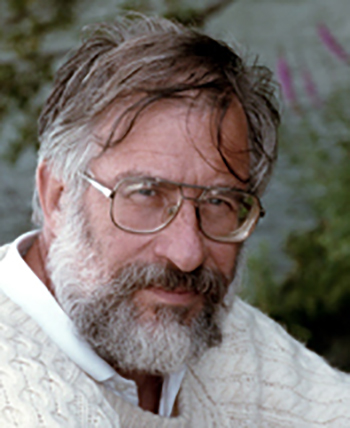
EERO PALOHEIMO
THE WAY
TOWARDS A NEW EUROPE
THE IDEA
The idea originated in the author’s concern for the future of mankind, coupled with his knowledge that the technology required to solve most of the problems either exists or is known. All that is required is the political will to take the momentous decision. This book, therefore, is an eloquent and reasoned appeal for immediate action. It contains a frank appraisal of the present and future problems facing Europe, and offers a realistic technological programme for their solution over the next 40 years. It is not a techno-utopia or work of science fiction, but a plan for the future that is both necessary and reasonable.
THE BOOK
The book, which is about 450 pages in length, is divided into two parts. The first and shorter part discusses the principles involved, the second part consists of a model plan to ensure the survival of our world.
Under principles the author defends his thesis that an immediate and radical transformation of the system of production in industrialised countries is both necessary and inevitable. This is set against a backcloth of other studies and proposals concerning our global future. He then outlines how international agreement and cooperation will make this possible, without minimising the magnitude of the changes in thinking involved. Although the author limits his analysis to the highly integrated Europe of tomorrow, his basic argument is global. Likewise he is more concerned with the practical means for attaining the goal, rather than visualising the outcome.
A realistic picture of the future is provided in the second part in the discussion of the plan and new technology. This concerns a wide range of subjects including population control, a continental nature conservation area, land use, self-sufficiency in food, the diversification of forests, alternative sources of energy, an economy based on recycling, ecological villages and the new agriculture, ecological towns and infrastructures, the future role of information technology, the new magnetic levitation railway system, cybercabs and local traffic, and the automatised and electronic distribution of goods. All of the technologies involved are based on existing realities. Likewise the solutions proposed are backed by cost calculations and estimates of the amount of work involved. The book also discusses the various specific initiatives being made within EU circles.
THE AUTHOR
With doctorates in technology from the universities of Munich and Helsinki, a successfully career running his own structural engineering design office, and his recent appointment as a professor at the Helsinki University of Technology, Eero Paloheimo is superbly qualified to write about the technology of the future. As a founder member of the Green Party of Finland and its former MP, chairman of the all-important Parliamentary Committee on the Long-Term Future Questions of Europe and Finland and extensive writings on the problems facing mankind, Mr Paloheimo brings to the book that essential humanity that makes it both readable and convincing.
Eero Paloheimo’s book is intended to appeal to the broadest possible audience because his solutions call for tough political decisions and these, in a democratic Europe, cannot be taken without widespread understanding and approval. To make sure of his message, he neither oversimplifies or underestimates the realities of today and tomorrow.
THE PUBLISHERS
Established in 1878, Werner Söderström Ltd is the oldest and largest publishing house in Finland. In 1994 it published …… titles, including novels by Finnish and foreign writers, poetry and plays, and a wide range of non-fictional works from textbooks and encyclopedias to biography and the arts. Eero Paloheimo’s THE WAY. Towards a New Europe, is scheduled for publication in Finnish in spring 1996.
LIST OF CONTENTS
PART I
PRINCIPLES
The book is divided into two parts. The first part deals with the problems facing mankind, then goes on to discuss the bases for the solutions proposed in the book, the principles governing their practicality and the difficulties involved, and as well as opinions on the various alternative and competitive solutions. Part I, which is not illustrated, consists of the following seven chapters.
THE PROBLEMS (First extract)
The problems facing the world are specified by reference to the “The Limits to Growth” and “Beyond the Limits – Global Collapse or Sustainable Future” reports. The main part areas concern halting the growth in population, new forms of development aid and the radical reform of production in the industrialised countries. This book is only concerned with the latter question, and then only within the context of Europe. Countries excluded from the study are Iceland and those within the former Soviet Union with the exception of the Baltic states.
THE GOAL
A broad outline of the ideal situation to be aimed at in the centuries to come is presented. The purpose of this book is not to describe the goal itself, just the means for its attainment, the way. As the solution presented is highly technical, the purpose of this chapter is to assure readers that the technological stage, though imperative, is only intermediary and lasts but a few decades. It is the means for achieving the deeper and more humane ultimate goal. The objective is to halt quantitative, material growth and our hectic life style, and replace them by something more sustainable and tranquil.
THE SOLUTIONS (Second extract)
The essential conditions for the solutions are stated. The solutions are far-reaching and include the total reform of all aspects of production. No one company can do this, neither one country. International cooperation is required. It is necessary to arrive at a firm supra-national decision concerning the change in direction. After this world-wide planning and design competitions produce solutions for the various part-areas. Examples of such competitions are given. They should yield ideas, lead to inter-state agreements, changes in national legislation and ultimately concrete action.
THE ZEBRA
In order to avoid any misapprehension that this book is proposing a techno-utopia model for society, this chapter imagines an intermediate society which, rather like the one ultimately aimed at, would be dualistic. On the one side, a system of production would be developed that no longer uses natural resources or pollutes, but is modern, technologically advanced and robotised. On the other side and parallel to it, people’s lives would revolve around an intimate and human-oriented everyday. Thus the “mega machine” would only be the instrument, the means, for a more humane life style. The parallel existence of these two forms of production is called the zebra.
THE LAW
Political change is required to support technological reform. This chapter criticises contemporary political dialogue because it is bogged down in trivia and more concerned with the past than the future. Political dialogue should pay greater attention to the burning issues of the future of the world and, particularly in Europe, to the role this continent is to play in their solution. This should bring legislation into line with contemporary needs. In addition to amending laws, a complete reform of teaching and education is required. These matters are discussed in detail, as technological improvements alone are not enough.
THE TASK
The projects suggested involve a colossal amount of labour and it is the purpose of this chapter to provide a rough estimate of the work involved. The goal is the transformation of the production of goods into a system based on recycling, the complete overhaul of transportation, and changes in land use to allow for the construction of a conservation area running the length of Europe and the restructuring of agriculture and forestry. This calls for a fundamental change in energy generation to eliminate the use of fossil fuels and air pollution. A rough estimate is given of the overall amount of labour required and the result compared to the more than 20 million unemployed as well as the millions engaged in unproductive work in Europe today. It proves that two birds can be killed with one stone: the spectre of unemployment and the problems of the environment.
THE ALTERNATIVES
This chapter defends the principles involved in the solutions against anticipated criticism. Two seriously competitive alternatives are discussed. The first is a return to pre-industrial times: a significant reduction in population, production and consumption. Though technically feasible, it is psychologically and politically impossible. The second alternative discussed is the road of minor change which, though realistic and politically acceptable, is too slow. Although it would impede the disaster, it would not prevent it. Neither of these alternatives works; what is required is a radical change, a new industrial revolution. The chapter concludes with a justification as to why Europe is the most suitable continent for the introduction of new technology and industry.
PART II
THE PLAN
Part II discusses a concrete plan for the future development of Europe. It describes the new industry and technology, and calculates the amount of labour required and the costs involved. It contains 26 chapters grouped under eight different subject headings, with some 100 illustrations: maps, drawings and photographs.
LAND AND POPULATION
In relation to its area and population, Europe consumes about five times more global resources than to the rest of the world. It is proposed that the population of Europe be allowed to fall to about 40 per cent of its present level over the next 300 years. The aim should be a 5 per cent decline within two generations, mainly concentrated in the more densely populated countries. There would be a complete redivision of the use of land between agriculture, forestry, etc.
Present and projected land usage is shown in maps.
NATURE
The principles governing interaction between man and nature are discussed under the main heading. They form the theoretical background to the concrete proposals made in the following two chapters.
Nature conservation area
The plan is for an enclosed nature conservation area the length of Europe, with roads and railways running underneath in tunnels. It would be about 10 000 km long and vary in width from 100 m to 10 km. It would extend northwards from the south of Norway to the Arctic Ocean and southwards to Gibraltar and southern Greece. The purpose of the area is to provide living space for Europe’s 29 largest mammals. It would be allowed to develop naturally and man’s movement within it would be restricted. Later on, as Europe’s population declines, the conservation area would be extended.
Other protective measures
An enclosed area is only necessary for the protection of larger mammals. The protection of other animals and plants can be arranged, for example, through improved forest management. A data bank of all species of flora and fauna found in Europe will be created. The development of species and their protection will be monitored annually and their living conditions guaranteed under international agreements. How this happens is described with detailed examples for one plant and one insect.
FOOD
Ideas concerning the importance of food for people and the philosophy of food production are discussed under the main heading. The starting point is continental self-sufficiency in food production. These ideas provide the bases for the concrete proposals made in the following three chapters.
Animal-based foods
Animal-based foods at present consumed in different European countries are specified and compared with health recommendations. The plan should be adjusted to steer present-day practices in a more ideal direction. This chapter analyses the total amount of land required to produce the ideal quantity of animal-based foods, and recommends concentrating their production in the areas where they are consumed. Europe becomes self-sufficient in both animal-based foods and feeds. New laws are proposed to make animal husbandry more humane.
Vegetable foods
This chapter provides an inventory of the vegetable foods and grain crops of different European countries. The idea is to have sufficient arable land to ensure self-sufficiency and to reduce trans-continental transportation of produce. An industrial model for cultivation is introduced in which satellite-controlled, unmanned agricultural machines do all the work. This is the mass aspect of agriculture and is clearly differentiated from the humane and small-scale farming of the zebra model.
Greenhouse cultivation and fishing
This chapter discusses the lesser branches of the food industry. Estimates are made of the amount of energy used and the profitability of greenhouse cultivation in the different parts of Europe. An ideal model is presented of the number of greenhouses required to achieve self-sufficiency in Europe. Europe’s share of fishing in the world’s seas is criticised as it is too large. This is one reason for reducing the population of Europe in the future. As the world’s fish catch has fallen in recent years, the question thus concerns a limited natural resource.
FORESTS
The importance of forests and wood to man is discussed under the main heading. Fields compete for space and sunlight with forests, bread with paper. Forests are important economically, aesthetically and ethically. These thoughts lead to the next two chapters.
Forest management
This chapter discusses how far industrialised forestry can be pushed towards conservation and diversification without incurring any economic loss. The amount of work would increase, but also the quantity of timber. In order to satisfy its raw material needs for cellulose and timber, Europe, in addition to its own resources, draws on a reserve of some 250 000 km2 of forest beyond its borders. Self-sufficiency is the goal of the plan and land use would be changed accordingly. A new type of forest harvesting machine is introduced.
Forest industry
Nowadays, as well as in the future, the main products of the forest industry are sawn timber and paper. Life-span analyses are made for both covering the whole continent. The plan for the future is based on the use of sawn timber, as it is hoped to largely replace concrete and steel in building with renewable materials. New techniques of processing wood are introduced. Paper is recycled and its use reduced in wasteful countries – like Finland. Paper will be partly replaced by electronic data transfer and storage.
ENERGY
General ideas on the basic nature of energy and its importance to man are discussed under the main heading. Europe’s coal balance is distorted: the continent’s effect on global warming is disproportionately great. Three alternative solutions are considered.
Oil, coal and natural gas
The balance of fossil fuels, coal and CO2 emissions, in Europe is grossly uneven. It imports most of its coal and oil requirement, and discharges into the atmosphere far more carbon dioxide than its absorbs. Purification of coal-burning power plant emissions has been experimented with in Japan, but the price of energy increases too much. Purification is thus not the answer to CO2 emissions. A part solution, especially in North Europe, is the industrial use of energy forests and waste wood. As energy forests absorb CO2 from the atmosphere, the equilibrium is maintained.
Fission and fusion
Here the various merits of conventional and breeder reactors, and fusion reactors are discussed. The first cannot be considered a long-term solution as uranium reserves are only enough for about 30 years. Breeder reactors can solve the problem because the fuel can be used for 50 to 100 times longer. However, because the safety of breeder reactors is very critical, they too cannot be considered a feasible solution. Fusion reactors do not have these drawbacks, but the price of the energy generated is considerably higher than nowadays. So even this solution is still not practically realistic.
Sun and wind
In the plan, the future of Europe’s energy is solved by a three-layer power plant which combines windmills, solar panels and underground pipelines complete with heat pumps on the same site. The number of sites required is calculated and indicated on the land use maps. The anticipated price per unit of power plants is estimated showing that it will fall to about a fifth of the present level if output is increased by 1000 times. These power plants will then be economically competitive. The solar power plant industry would then approach the level of the automobile industry today. New solar panel techniques are compared.
Traditional energy and saving
This chapter discusses traditional energy generation and saving, in particular the production of electricity in hydro-electric plants and in the mountainous countries of Europe. It is noted that this is not the solution for the future, as the continent will not be satisfied with so little energy. Saving is an important factor during the intermediate stage when the use of fossil fuels should be reduced, but there is still insufficient solar and wind generated energy. Analyses are made of the amount of energy included in production and products, likewise life-span analyses are made compulsory throughout the continent.
PRODUCTION
General ideas about production. Commodity production is made recyclable. The recycling of materials is incorporated in product design. The complete transformation of industry is proposed. As robots do not need to be treated humanely, tomorrow’s factories are located underground.
Recycling of products
Products are divided into different groups according to their useful life. The recycling of packagings, machines, other products and buildings are treated separately. A recycling strategy is designed for each group. This means the renewal of products, as well as the production process and transportation. The recycling of objects is the first stage of the process. Then comes the recycling of materials. These are divided into three groups and the recycling of each one is dealt with separately.
Recycling of metals
The recycling of metals is the most developed field today. The most common material is steel and this, like the other metals, is considered by itself. The process is discussed stage by stage, also the quantities of materials for recycling in Europe. The problems are specified and a continental system developed for the recycling of scrap metal. This is based on a network of recycling plants, updated by an on-line data base of quantities and types of scrap metal available, scrap exchanges, electronic ordering and express delivery via pipelines.
Recycling of plastics
Plastics are more difficult to recycle than metals. Three alternative systems are discussed: mechanical, chemical and atmospheric recycling. The latter means either burning or the use of biodegradable plastics. The latest German developments in chemical recycling are analysed. The factors to be studied to make plastics recycling feasible are: regulated production, informative labelling, centrally-controlled recycling and transportation, and chemical-based process development.
Recycling of minerals
Recycling minerals is mainly the concern of the building industry. Buildings are still made to last, not to be dismantled. Their design in the future should be on the same principle as other products. The designer has to calculate their useful life, possible dismantling, and incorporate into his design the idea of reusing either all or part of the building. Some of the minerals could be used in land work, others as such in new building.
Preservation of the old
The maintenance of the old is one of the most important part-areas of modern production. It is equivalent to saving energy in the generation of energy. This chapter deals with the aging of products made from different materials as well as the restoration of objects. The examples given range from cars and furniture to buildings. Legislation is proposed for the preservation of old objects, which would apply to the whole continent.
Production of skills
Future products would incorporate less materials than now, but proportionately more know-how. Every factory, vehicle, apartment or appliance would contain electronics, and programming and design would constitute an ever greater part of the product’s value. Even more important is the share of knowledge in future mega-structures, the ideaing of which would be senseless without new information technology. Know-how, the production of skills, becomes more important than materials in future production, as well as in this plan. The chapter also discusses information networks and virtual reality environments.
COMMUNICATIONS
General ideas on the movement of information, people and goods; an ideological background to the practical examples given. These three aspects are considered separately and from different starting points.
Data communications
The development of data communications is the most astounding part area. The plan for the future includes a multi-purpose info panel in every workplace and every home, which also functions as a HDTV, private videophone, notepad, doctor, conference table, university and teleshop. Alongside this virtual reality data transfer will be developed, as well as individual mobile data transmitters of which today’s mobile phone is but a pale image. The development of the optic fibre cable and the optic transistor will open the way forward.
Arterial passenger traffic
A maglev, magnetic levitation, railway will be constructed throughout Europe, based on a four-track main line enabling a journey from St. Petersburg to Lisbon to be made in 8 hours. Passengers join or leave the train from shuttle lines travelling parallel to it at the same speed. These local shuttle lines are organised in a trans-continental network. Beyond the main line, the shuttles would travel more slowly, at only 200-300 km/h. Although air flights within Europe would be finished, those outside the continent would continue.
Capillary passenger traffic (Third extract)
The main and local line arteries are combined with capillaries, feeder lines, which are noiseless, non-polluting and safe. The plan suggests a network of cybercabs, rather like automatically-controlled sedan chairs. Everyone can use them and they are all integrated into a central traffic control computer. The cybercabs are not manually operated, but powered and controlled from underground cables. One central computer covers an area of about 2000 km2 and Europe is divided into numerous control zones, each with its own cybercab system. Cybercabs can be driven manually for short distances.
Secondary traffic
Secondary traffic, such as bicycles, skis and various types of carts, will return to rural villages and ecological metropolises alike, as a parallel, alternative mode of transportation to the above mentioned cybercab system. This is one example of the white stripe on the zebra.
Goods traffic
A network of pipelines underneath the railways will be built for the transportation of goods in Europe. The goods move within the vacuum pipes according to the principle of magnetic levitation. Because of the vacuum, energy consumption is negligible, and goods can be “fired” at high velocities from one part of the continent to the other. Goods traffic is divided into three systems. Although light loads can be transported by the most human-oriented method of pushcarts, heavier loads will go by automatic cybercab. In the big cities, a building-to-building network of vacuum pipes will be built. Such systems already exist for hospitals in Prague and Malmö.
EVERYDAY LIFE
This chapter discussed the essential principles of living, of work and home life. It also reveals the effect of the above mentioned transformation of the system of production on everyday human life.
The eco-village
It is proposed that eco-villages be built throughout Europe in which there are no cars, and no external waste and water systems. The village produces most of its own energy and food. This chapter offers a detailed description of the working of such a village. Data communications and teleworking are the norms of the new life style. Village designs may vary considerably. The plan for one such village is given and an example of how they would be located in one part of Sweden.
Renovating old villages
Alongside the new eco-villages, the old ones will be renovated to make them ecologically sustainable. This is a special case of the preservation of the old. Town plans are upgraded to allow for the building of greenhouses and a nearby power plant, land is cleared for cultivation and grazing, a local waste disposal and water supply system is created, as well as a carless system of traffic. Data communications are developed to make teleworking the norm. People’s lives in the eco-villages are described.
The eco-metropolis
The modern metropolis is converted into one with an ecologically sustainable basis, with Vienna being used as the example. The city’s water becomes recyclable. Food supplies and compostable waste are conveyed daily through pipes to and from the nearby countryside. Goods are also delivered through pipes. Data communications are highly developed. Cars have been supplanted by cybercabs. Water closets are replaced by compost toilets. The life of people in the towns is described.
LABOUR AND COSTS
This chapter presents calculations of the amount of labour, time and costs involved in the above mentioned projects.
ENCLOSURES
This includes a bibliography, and the calculations and statistics for the illustrations. The text size is smaller as it is only intended for reference.
